
Marketing problems are often structural long before they appear tactical.
In many technical and B2B organizations, marketing does not begin as a formal system.
A website gets built.
Proposal templates evolve over time.
Different people explain the company differently depending on the client, opportunity, or project.
Conferences create visibility.
Content gets produced when there is time.
Business development grows through relationships, expertise, and reputation.
For a while, this works.
Then the organization grows.
More services are introduced.
More people become involved in communication.
More coordination is needed between leadership, operations, business development, and marketing.
The company becomes more visible, but internally people are still having the same conversations repeatedly about how the business should actually be described.
At this stage, most organizations assume they have a marketing problem.
So they start fixing things individually.
The website gets redesigned.
Messaging gets refreshed.
LinkedIn activity increases.
A marketing coordinator or consultant gets brought in.
More effort starts going into visibility, communication, and consistency.
Some improvements usually happen quickly.
But underneath it all, the same friction often remains.
The website may position the company one way while proposals tell a slightly different story.
Leadership emphasizes one strength while project teams focus on another.
Sales conversations shift depending on who is leading them.
Prospective clients understand the capability, but still leave with different interpretations of where the company is strongest.
From the outside, the organization looks active and established.
Inside, it still feels harder than it should.
This is where marketing usually stops being a visibility issue and starts becoming a structural one.
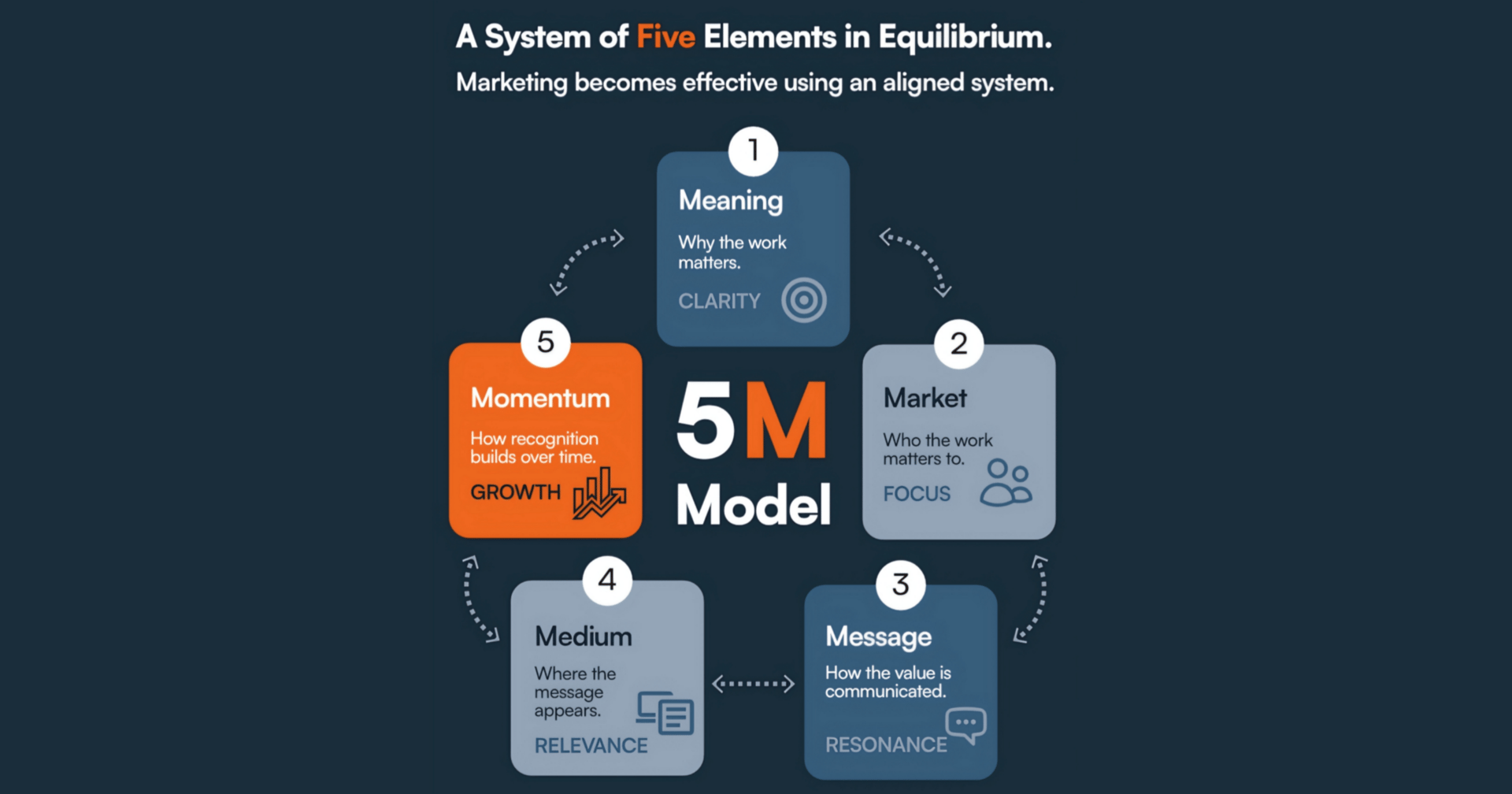
Strong marketing depends on alignment across five connected areas:
Meaning: what the company actually stands for
Market: where the business is most relevant
Message: how value gets communicated consistently
Medium: where communication is experienced
Momentum: whether effort reinforces itself over time
When these areas evolve separately, marketing starts compensating for the lack of structure. Teams revisit the same messaging conversations repeatedly. Proposals become inconsistent between departments. More explanation is needed in meetings, presentations, onboarding, and business development conversations.
Over time, growth becomes heavier to carry.
Not because the organization lacks expertise, but because the business is being interpreted differently depending on where someone encounters it.
Most technical organizations are already investing significant effort into communication, proposals, conferences, content, and marketing activity.
The challenge is that these efforts were often built gradually as the organization evolved, without a structure designed to hold them together.
Once that structure exists, the shift becomes noticeable.
Positioning becomes easier to maintain. Messaging carries more consistently between departments. Marketing and business development begin reinforcing one another naturally. The same effort that once felt scattered starts building momentum instead.