
When Marketing Becomes Fragmented
In many technical organizations, marketing becomes associated with isolated activities rather than a connected business system. Social media, conference attendance, proposals, websites, business development, and brand visibility are often treated as separate efforts owned by different people across the organization.
Over time, this creates inconsistency.
An organization may have strong technical expertise, credible people, and valuable services, yet still struggle to clearly communicate why the work matters, who it is for, and how that value should be recognized in the market.
This is especially common in environmental, engineering, scientific, and technical industries where project delivery naturally takes priority over communication strategy.
The result is not usually a lack of expertise. It is often a lack of alignment.
Marketing can quickly become reactive:
updating a website because it feels outdated
posting on LinkedIn only before events
redesigning brochures without clarifying positioning
attending conferences without a clear market focus
expecting immediate ROI from disconnected activity
Over time, organizations begin doing many marketing-related activities without a shared structure tying them together.
Marketing Works More Effectively as a Coordinated System
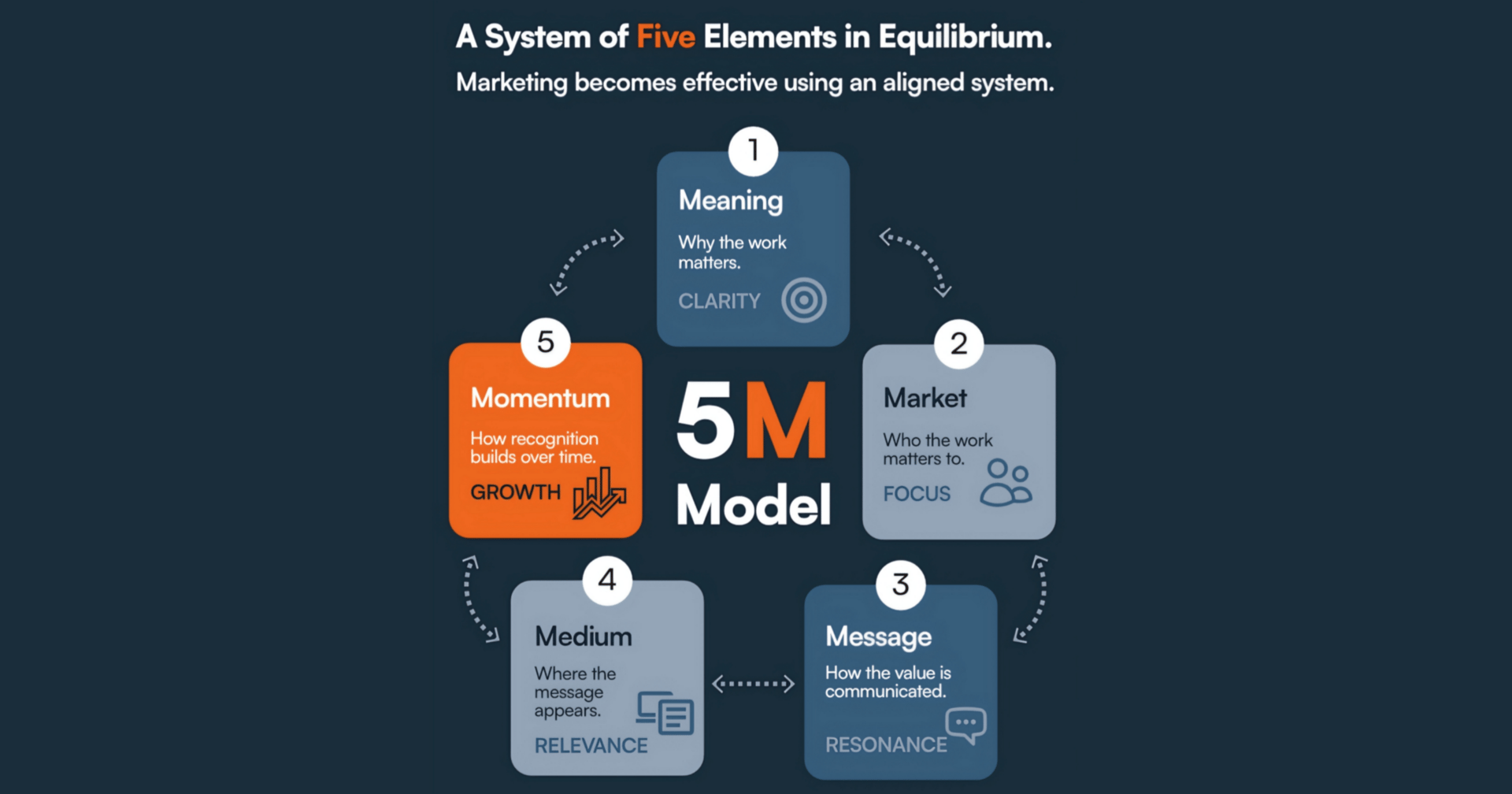
The 5M Model was developed as a way to help organizations approach marketing more systematically.
Rather than viewing marketing as a collection of disconnected tactics, the model encourages organizations to examine how five connected areas influence one another over time:
Meaning
Market
Message
Medium
Momentum
Each area affects the next.
If the meaning behind the business is unclear, messaging becomes inconsistent.
If the wrong audience is targeted, visibility loses effectiveness.
If communication feels disconnected across touchpoints, trust and recognition weaken over time.
The framework also reinforces an important distinction: marketing is not the same thing as business development or sales.
Business development focuses heavily on relationships and opportunity creation. Sales focuses on converting opportunities into commitment. Marketing influences how clearly the business is understood before those conversations even begin.
This is why marketing behaves much more like a coordinated process than isolated execution.
Much like technical disciplines themselves, effective marketing requires:
structure
testing
refinement
reinforcement
and consistency over time
Not every effort works immediately, and not every audience is the right fit. Strong marketing systems evolve through observation, adjustment, and long-term alignment.
The Goal Is Clarity, Alignment, and Recognition
Strong marketing is not about trying to speak to everyone.
It is about helping the right audience recognize the value of what your organization already does well.
That may involve:
refining positioning
improving consistency across touchpoints
clarifying audience focus
strengthening communication structure
or aligning marketing, business development, and technical delivery more intentionally
Technical credibility still matters enormously in environmental and technical industries. The challenge is making the value and relevance of that expertise easier to recognize.
Organizations often spend years refining technical process, operational systems, and project delivery standards. Marketing requires a similar level of coordination and intentionality to build long-term momentum effectively.
For many organizations, the challenge is not capability. It is finding the time, structure, and strategic focus to continuously refine and reinforce those efforts alongside day-to-day operational demands.
Start With a Conversation
Marketing becomes significantly more manageable when it is understood as a connected system rather than a reactive collection of activities.
The 5M Model offers a practical framework for evaluating where marketing feels aligned, where it feels fragmented, and where opportunities for refinement may exist over time.
If your organization is navigating challenges around positioning, communication clarity, audience alignment, or long-term visibility, start with a conversation about how your marketing system is currently functioning and where stronger coordination may help build momentum more intentionally.