
Misalignment becomes visible long before organizations formally recognize it.
Most technical and B2B organizations do not wake up one day thinking their marketing is broken.
Usually, the concern builds slowly.
A proposal takes longer than it should.
The website no longer sounds like the company people experience in conversations.
Business development keeps re-explaining the same things in meetings.
Different departments describe the organization differently depending on the audience.
None of these moments feel major on their own.
Together, they start creating drag.
This is often where marketing gets blamed first because marketing is the most visible layer of communication.
It is the website people see.
The proposal clients review.
The LinkedIn content.
The presentation deck.
The conference booth.
The case study.
The messaging.
So naturally, when understanding starts feeling inconsistent, attention shifts toward marketing.
But marketing is often reacting to the inconsistency, not creating it.
In technical organizations, expertise is spread across multiple people and departments.
Leadership sees the business through growth and direction.
Technical teams see it through capability and delivery.
Business development sees it through relationships and opportunity.
Operations may define value differently again.
Each perspective makes sense internally.
The issue is that they do not always reinforce one another externally.
Over time, marketing inherits all of these interpretations simultaneously.
One team wants the company positioned around technical rigor.
Another emphasizes responsiveness.
Another wants broader market appeal.
Another wants to focus on innovation or process.
The result is rarely catastrophic.
It is just difficult to hold together consistently.
That is why marketing in technical organizations can start feeling reactive even when the people involved are highly competent. Messaging keeps adjusting because the organization itself has not fully aligned around what it wants to consistently communicate.
This is also why increasing marketing activity often fails to solve the problem.
More content does not automatically create clarity.
More campaigns do not automatically strengthen positioning.
More visibility does not automatically improve understanding.
Activity compounds structure. It does not replace it.
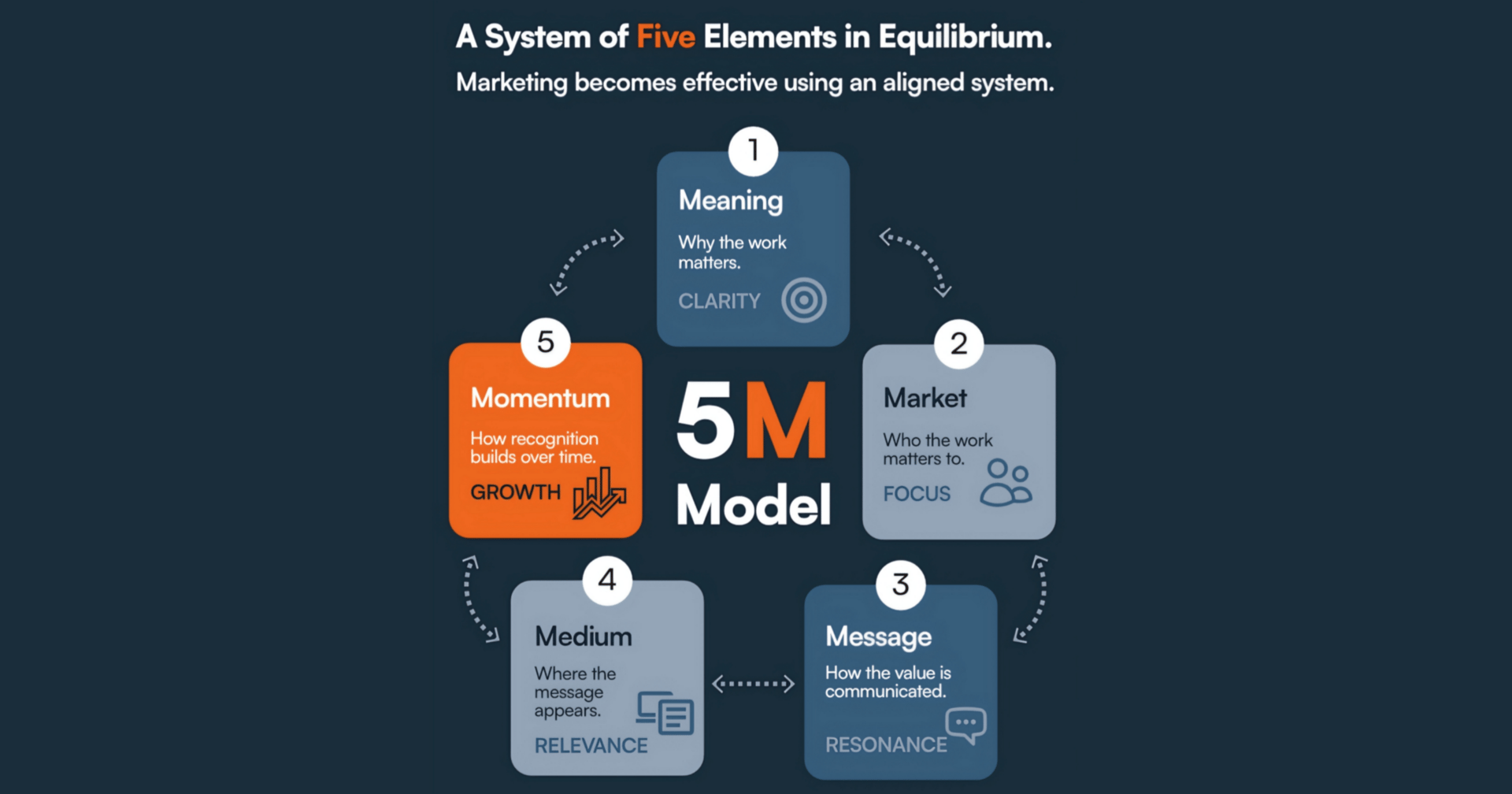
When organizations have alignment across meaning, market, and message, marketing starts reinforcing itself naturally. Proposals support the same understanding introduced by the website. Business development conversations feel more focused. Marketing becomes easier to maintain because communication is pulling in the same direction.
Without that alignment, every new activity introduces another interpretation of the business into the market.
That creates exhaustion internally and inconsistency externally.
Many technical organizations continue operating this way for years because the work itself is still strong.
Expertise still creates trust.
Relationships still generate opportunities.
Delivery still carries credibility.
But eventually communication becomes too distributed to rely on informal alignment alone.
That is usually the point where marketing starts feeling ineffective.
Not because nothing is happening.
Because too many disconnected things are happening at the same time.